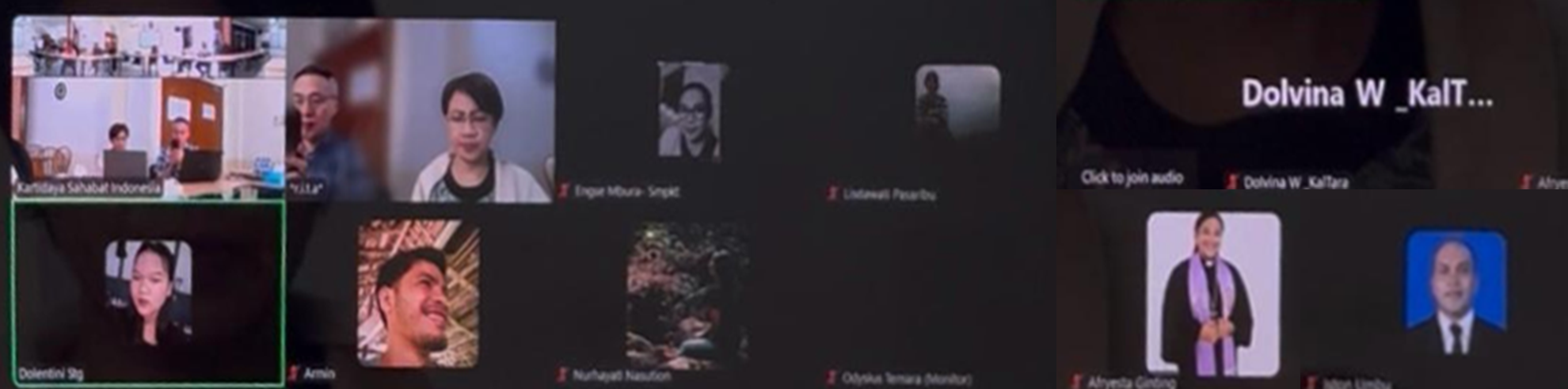
Kartidaya is a Bible translation mission organization established in 1989 by local Indonesian ministers. As previously mentioned, the Kartidaya Academy helps passionate and dedicated ministers from various regions of Indonesia learn effectively and gain experience by providing them with effective training and then immediately deploying them to the language project field, where they can apply their skills directly to Bible translation ministries. Starting this year, Wycliffe Canada has begun partnering with this ministry through a donor-led project. Accordingly, while en route to the Asia-Pacific Area Conference, Gyoojun stopped over in Indonesia to meet with Kalditaya leaders. He also had the opportunity to connect via Zoom with Rita, the Kartidaya Academy coordinator, as well as with Bible translation missionary candidates and field workers affiliated with the academy who are currently serving in various regions across Indonesia.

[In the center is Nely, CEO of Kaldidaya; on the far right is Rati, General Coordinator of the Kaldidaya Academy; and in the middle are intern missionaries Juan and Lewi, who are currently undergoing training and engaged in Bible translation ministry.]
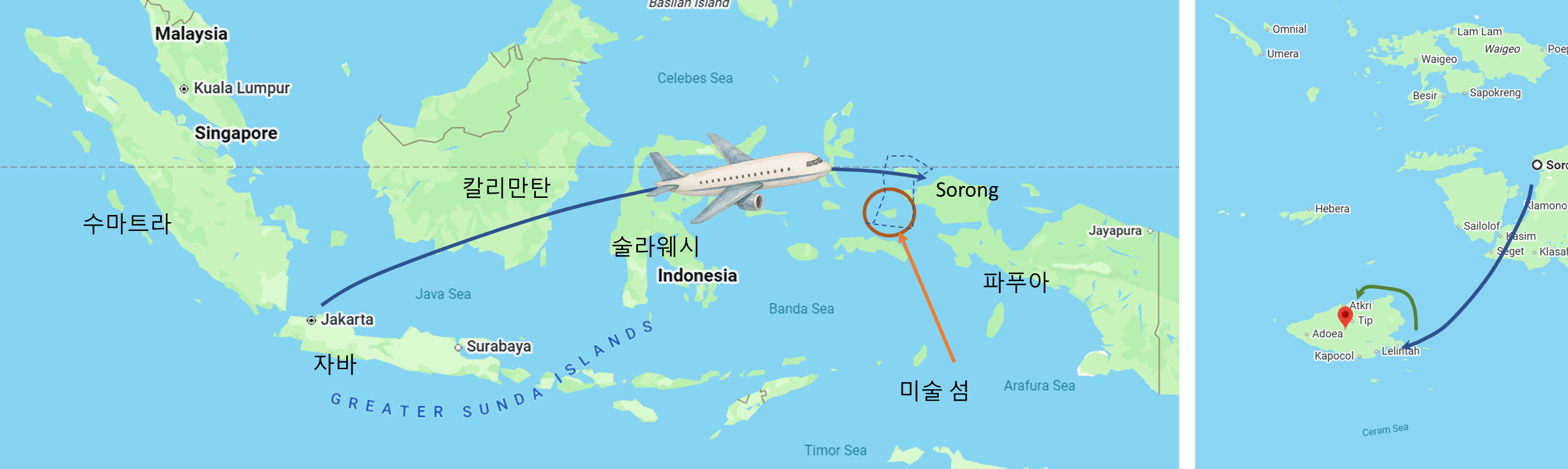
All of them are serving in ethnic minority group areas that require a full day or two of travel by plane, land, and/or water. As shown on the map below, these include areas south of Sumatra, west and east of Kalimantan, south of Sulawesi, and the western islands of Papua province. For example, to reach the area where Nurahyati serves, one must fly from Jakarta to Sorong, the capital of Southwest Papua, then take a 10-hour ferry ride to the southern part of Misool Island, and finally board another small boat for a voyage of over two hours to reach the Mambat-speaking community in the northern part of Masil Island, Len Malaas, where she serves.
As briefly mentioned in the weekly prayer topics, local ethnic minority Bible translators working in all these regions devote a few hours a week to Bible translation while holding down their day jobs; since this is not the same as working on the project continuously, it is challenging to make steady progress in the translation work. Furthermore, in some regions, the languages feature complex grammar and even tonal systems, requiring a high level of linguistic knowledge and training. Therefore, Rita Nasution—who is providing training, mentoring, and care for these intern missionaries through this program—stated that these intern missionaries need a higher level of linguistic training, both quantitatively and qualitatively, and asked for our prayers as she plans to propose and implement an intermediate-level linguistics training program soon. Just as Ralph Winter reflected on modern missions—noting that simply establishing seminaries while neglecting the establishment of comprehensive universities was a shortcoming—Bible translation missions also face the reality that merely translating the Word is insufficient for it to be used properly. We must ensure that the Bible continues to be used—whether through literacy ministries or by developing methods of oral approaches—and, as a result, help the language in question flourish and develop. Without such sustained language development and growth, the Bible will not only fail to be used within the community, but it will also be impossible to communicate and interact with other linguistic and cultural groups outside the community.
According to the church-centered Bible translation movement proposed by ETEN—which has recently been striving to support Bible translation missions in various ways—local churches in mission fields must not only take a more active role in providing both material and spiritual support for the translation of the Bible into their own languages but also actively participate in the entire process of translation, the community/village checks, and the revision to help ensure high-quality Bible translation works in their own language.Two of the intern Bible translators currently in training confessed that they have not received sufficient support from local churches, making it difficult to conduct community checks of their translated drafts. They asked for our prayers that many people would be mobilized to assist them. In many cases, people come to a confession of faith in Jesus and are baptized during the village or community check process, so from the perspective of spreading the Gospel, this situation is truly changed with rigorous mobilization of the partnering/hosting churches.
Please pray with us:
- That all necessary training and resources—including linguistics, translation, and effective cross-cultural communication for the trainees, as well as the ministry of mobilizing local church and community—may be adequately provided and implemented
- For Rita, the coordinator of the Kalditaya Academy who is responsible for leading this work, as she currently handles all administrative, training, educational, and care duties alone; pray that she may be provided with the necessary personnel and needed partnerships with specialized training organizations in these areas,
- That Nely Hergendi, the CEO of Kalditaya, may effectively support and serve the intern missionaries in training at the Kalditaya Academy so they can successfully carry out their holistic missionary work,
- That the intern Bible translators in serving and training on-site may communicate effectively with local ethnic group leaders and maintain meaningful partnerships, and
- That the local mother-tongue Bible translators from each language group—who are dedicating their time to Bible translation ministry while also working to support themselves—may continue to serve faithfully.
|
